Friday, 3 February 2012

"The way of the world"- character interpretation and ideas

My character in our group scene is a maid called "Peg", After experimenting and analysing the script I have come up with a few characteristics which i would like to incorporate into the role.
  • I would like "Peg" to be loyal to "Lady Wishford", yet she can still get irritated by her arrogance and occasional selfishness. She shows this by sighs, secret looks and eye rolling.
  • I quite like the idea of making her rather nosey, She can be listening subtly to the conversations going on around her, yet she resists in-put (although its obvious that she would like to participate via eye and mouth movements). I believe that she would like to speak because if I was in her situation I would think that Lady Wishford and Mrs Marwood's conversation was slightly petty and immature, therefore i would want to subtly make them realise this. But in this situation "Peg" knows her place (as a maid) and knows better than to speak out.  
How is the scene developing and making progress (as a group)


The scene is becoming more structured and understandable with rehearsals and line learning, the ideas are developing and being used during rehearsals. Vocal skills are good as i would say everybody sounds in character and has added in comical characteristics to their voice (and movement skills for that matter). We have also discussed props and costume, we came to the conclusion that we would use an empty brandy bottle (cherry brandy), an empty liqueur bottle (red ratifia), plastic glass's and a mirror for the props, we have decided who will bring in which props to ensure we all know and understand what we need for the performance day. Costume wise we have all decided to find them individually, as we know our own characters the best. I have simply decided to wear a black top with an apron or cloth as i believe that is suitable for a maid.
Overall I believe we are working well as a group, sharing opinions and are making progress, yet further rehearsal and development is still needed.

Thursday, 2 February 2012

Thursday 2nd Febuary

Today was completely focused on our monologues. We had some time to rehearse independently or in groups, I read my monologue to Matthew and Peter (on my course) who gave me feedback so that I could improve. My feedback was that overall it was well-spoken yet I need to project  my voice further and add in more movements. I then listened to their monologues (Matthew and Peter) to give them feedback before rehearsing independently.

After a short break we got given time slots of which we could work on monologues with Sonya (our tutor), this gave us the chance to get useful feedback, to discuss what was or wasn't working and to develop new ideas.

What did this achieve?
  • I learnt that overall my vocal-skills during my monologue are good, i just need to project my voice further and leave gaps during the last part of my monologue (which is as follows)- "Do you mean to say that a modest appetite, a sober taste in dress and a dislike of card playing don't amount to anything tangible? Why they are a marriage portion and an inheritance rolled into one" as this would make it clear that she is both confused and slightly irritated that he isn't completely agreeing with her.
  • During a discussion with Sonya I have developed some new ideas, Although i was originally planning to stand up i have now decided that i could sit down opposite another chair (placed slightly forward so it is still visible), directing the conversation to an imaginary Mr Harpagon who is sat there!, this means i could also use props like photos which i would be showing to him (obviously photos were not invented in 1668!, but we can modernise the style of the monologues).
  • I can now experiment with the new ideas to finalise the blocking for my monologue, once it is finalised i can improve it with rehearsal.


The chairs would be positioned in this
manner so they are visible and so that it is obvious 
that Frosine is talking to somebody 


Wednesday, 1 February 2012

Wednesday 1st Febuary

Today was based on independant study, scene work and rehearsing monologues.
In the morning I rehearsed "The way of the world" with my group, we looked through the script first and did a quick run through to familiarise ourselves with the lines and previous ideas (written on the script). We then got on our feet (group decision) to perform the scene and put it into practise (act it out), this was highly productive as we have developed and memorised parts of the blocking.
The afternoon was basically independent study (monologues and lines) and a small amount of scene work. I read through my monologue a few times before performing it off-script, I believe I have now learnt my monologue which means i can focus on the movement and vocal aspects of the monologue more thoroughly . We did a small amount of scene work ("The way of the world") which consisted of idea devising, line learning and rehearsing: So what did this achieve?
  • We have come up with an idea for our scene- Mrs Marwood gets pushed into the closet to hide from Foible,  yet she puts her glass out and looks at peg for a refill (blatantly not attempting to keep hidden effectively!)  and Peg (the maid) is trying her very best to cover for Mrs Marwood by taking the glass and pretending it was hers.
  • I have rehearsed and learnt my monologue so i can focus on other important aspects
  • As a group we have developed our scene further and gained ideas and blocking.
http://www.enotes.com/way-world- if you would like to understand more about "The way of the world" the link will explain the plot and history :-)

Friday, 27 January 2012

London - Sites visited and information I have gained


Inside the globe theatre.
It was interesting to view the
 estimated layout and
 style of  the globe

I went to London with college for 3 days; We visited some sites which I have found helpful for this unit. These included The Globe theatre, the new London theatre, the Royal Opera house and St Paul's (the actors church). It was interesting to discover how theatre has evolved from Shakespeare's time. Theatre was hated by the church, women were not allowed to act and the style of plays were different yet still effect theatre today. During the Restoration women were finally allowed to act, some church's were accepting theatre  as a good thing and  plays were becoming increasingly popular. Nowadays theatre and drama is a huge part of life, and comes in many different forms e;g theatre, ballet, comedy, pantomime, TV. It is completely accepted in society and is enjoyed by millions if not billions of people.
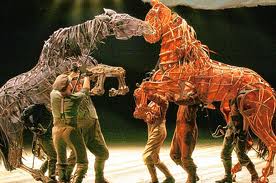
We also went to see the show War horse in the national theatre, this was a great example of how focused you need to be when performing, as it was clear that every performer was completely focused and giving the show everything they had.
The actors controlling the horses must be incredibly
focused to move the horses in co-ordination with each
other. They also have to make precise movements and sound
at the correct moments throughout the performance.
They did this brilliantly which made you see the puppets
as real horses during the show.

Monday, 23 January 2012

Frosines Monologue, ideas and rehearsal/ Molieres intentions

I have realised that when I perform my monologue I don't move or use gestures enough, this makes it look a bit wooden. Therefore I have been experimenting with gestures and movements which my character would use, I have come up with a  few ideas which i could in-corporate:
  • When my character is calculating sums in her head, she could be counting on her fingers to make sure shes right
  • I could add in a small pace or wander to make it look less awkward and wooden
  • When there is an important line e.g. "why this girl will bring you twelve thousand a year" (as it is a persuasive line), i should put emphasis on the important words to make them stand out and make a point.
I am still experimenting with my monologue to see what suits my character in terms of movement but also with her intonation and volume. I have realised the importance of these skills, because you can know a monologue and read it out but this means nothing unless you can actually perform it, as in create a character and show its meaning.


I was also curious to see where Moliere took his inspiration from and why he wrote "The Miser".
I found out that he was in a way adapting a fable ("The miser and his gold") about a greedy man who buried his gold (Harpagon also buried his gold). The man checked on it every day, until one day his gold was stolen. The man realised that the gold hadn't helped or made him happy in any way, therefore a buried stone would have been just as useful, so he buried a stone in its place. The morale of this story is that money is not the most important aspect o life and can do more harm than good. This is of great importance because there are many similarity's between this and "The Miser", Harpagon harmed many people out of greed including his horses (half starved them), he turned his children against him who later stole his gold!, and basically for a useless substance as he never put his gold to any use. I believe  Moliere was trying to tell people to care about their family and Friends over money.
                                                                      

This is a video which explains the fable in simple terms, it may be helpful to view it :-)

Saturday, 21 January 2012

Independant study

I have decided to do some independent research into Restoration theatre, I decided to research the audience as i have little knowledge of audience's during Restoration drama/comedy.  

    William Hogarth: The Laughing Audience, 1733
  • Restoration drama was essentially written by Charles's courtiers for his courtiers and it was vibrant, colourful, brutal, and bawdy. Restoration audiences were notoriously ill behaved, often more interested in the drama of their own lives than that on stage.
  • During this time the theatre was a "playhouse for the upper crust of restoration society".
  • there are accounts of audience members climbing onto the stage (even though this was unsuccessfully forbidden in Charles 11's reign). Not only this but quarrels often took to the stage, which did on occasions cause injury.
  • Orange Wenches- groups of women who would force their way through the walkways to sell fruit, they were tolerated but not liked as their prices were often extravagant.


Different audience sectors:
  1. The Pit- a seat here cost half a crown (12p), although you were expected to keep to your seat all the way through the performance. This was by far the noisiest and rowdiest area of the auditorium.
  2. The Boxes- This was the most expensive area costing 4 shillings (20p).Boxes were used to host the higher class, mainly women and their protective husbands.
  3. The Galleries-This area was for the lower class of society and is often not accounted for in contemporary accounts.
http://www.st-andrews.ac.uk/~rtheatre/Theatres/Area_Aud.html- this is the link used to gain this information, therefore if you'd like to know more click here.

Friday, 20 January 2012

Friday 20th january

Today gave us the opportunity to work on our presentations or do some research.
I began my presentation, my original idea was to simply have a picture presentation and read the information separately. In the end i have done some slides with just pictures with the odd comment, yet i have added text on slides which need an explanation to make them understandable. I am still planning to learn and understand the information further so i can explain the information without constantly looking at the PowerPoint. I researched information about the Restoration period, the history and influences behind theatre at that time. I learnt some really useful information about restoration comedy and its social and historical influences.

here are some of the websites i used:

An interpretation of Frosine and Mr Harpagon from "The Miser",
its helpful to look at different interpretations as it can help create ideas
and give you a greater understanding of how your character might dress
 This research gave me a greater understanding of Restoration comedy, this in turn helped me to understand "The Miser" and "The way of the world" as i understand some of the meanings behind them e.g "The Miser" outlines greed, love and serendipity (luck). I believe that it's crucial to understand your plays, characters and the ideas behind them, as it helps you to portray and explain your character more convincingly and in more detail.
I am going to do some research in my independent study time so i can improve my knowledge in this area.